

TWILIGHT
Analog control (1-10 V)
The oldest and simplest method of regulation. It is mainly used for small systems in conjunction with a manual regulator or a daylight sensor for automatic regulation.
Manual controller (1–10V)
The 1-10V rotary regulator controls max. 50, switches max. 10 single-source or 5 dual-source luminaires, or 5 pcs of 4x18W luminaires. The number of switched luminaires can be increased by using a contactor.

Basic dimming wiring – analog (1-10 V)
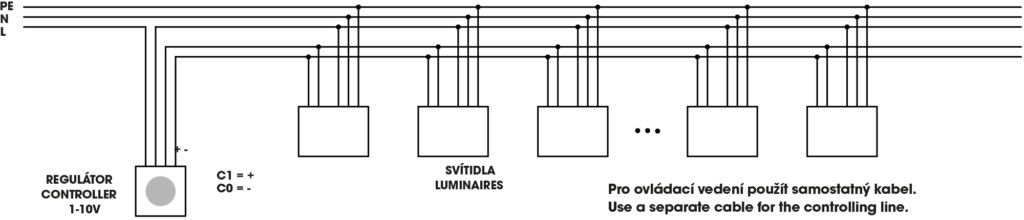
Dimming connection with contactor – analog (1-10 V)
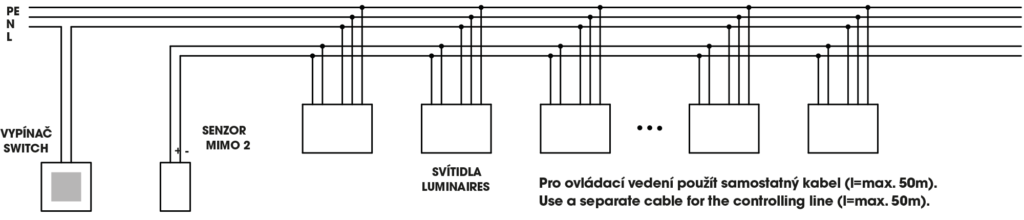
Daylight sensor
It is necessary to specify whether on T5 or T8
MIMO 2 sensor (1-10V). Regulates automatically to a constant lighting level adjustable in the range of approximately 200 – 600 lx. Allows you to regulate up to 15 ballasts (luminaires).

Dimming wiring diagram – MIMO2 (1–10 V)
DALI – digital control
Example of marking: ZC228/12LOSZK+DimDALI
The most modern method of lighting regulation and control used for modern installations to integrate the system into an intelligent building management system.
(Digital Addressable Lighting Interface) offers new possibilities. The DALI system is defined as a “Master-Slave” system in which control modules that send commands and ballasts (luminaires) that receive commands communicate with each other. The entire system is built for 64 components, which may not only be luminaires, but also relay modules for simply turning on/off anything. These 64 components can be grouped into up to 16 groups, and components do not have to be in only one group. Furthermore, up to 16 scenes can be set.
All luminaires are connected using a two-core wire and all settings are made after the luminaires are installed. For this reason, it is possible to change the grouping of luminaires at any time in the future. Then, for example, it is possible to change the lighting method from individual rows to individual columns, or to control one luminaire separately and then the rest. All this without interfering with the electrical installation.
Control modules can range from the simplest ones, which can be imagined as ordinary buttons that can be used to turn a group of lights on, off or call up a certain scene. A scene is a certain setting that has been saved in memory and can be returned to at any time.
One of the scenes can be, for example, normal operation, another dark state intended for presentations or perhaps just orientation lighting for a security patrol of the facility.
The control module can also control the system depending on daylight, or function as a receiver for a wireless controller.
With the DALI system, it is possible to subsequently enter the system and adjust the configuration according to current requirements. The DALI system can also be integrated into systems such as EIB, LonWorks, and all similar ones.
If you are interested, we are ready to help you with a specific application.
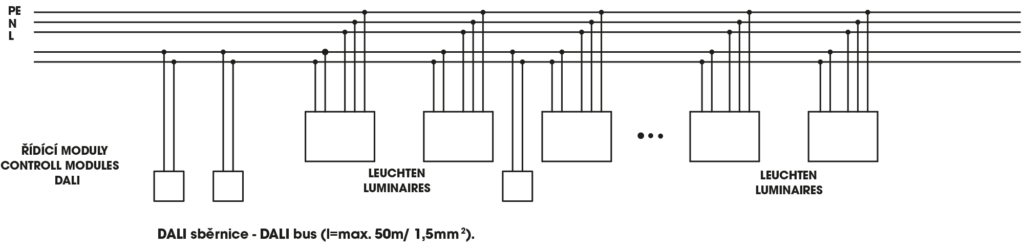
Basic dimming connection – DALI
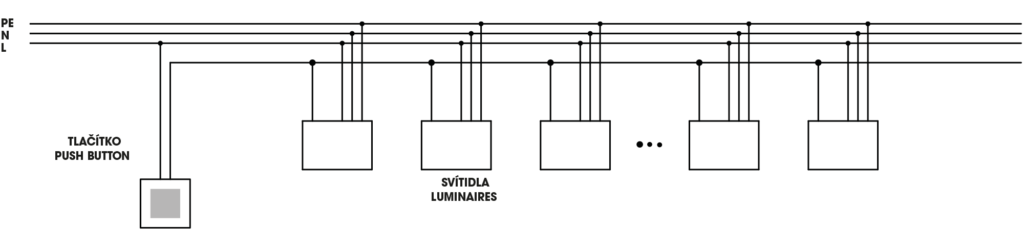
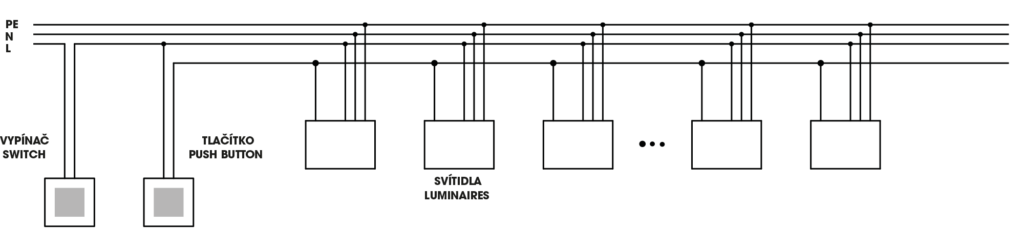
BUTTON control
TOUCH DIM
Another option is button control.
Some dimmable ballasts allow regulation with a simple button. The control then works as follows: Press the button briefly to turn the light on or off, press it longer to reduce or increase the brightness.
The number of ballasts controlled in this way is theoretically not limited, but it is recommended for systems of up to 20 ballasts.
This type of control can be used advantageously for control from multiple locations (parallel connected buttons). We offer this control with HELVAR ballasts and TRIDONIC ballasts.
Features of the HELVAR “sc” ballast:
Control is carried out using zero. It is also possible to use a phase. The ballast has no memory, i.e. after switching on, the luminaire always lights up at 100%. Be careful, after a power failure, the luminaires will light up by themselves, even if they are turned off only with a button. This phenomenon can be prevented by pre-setting the switch. During operation, an asynchronous state may occasionally occur (some luminaires are on and some are not). You synchronize the luminaires by switching off the circuit breaker.
Features of TRIDONIC “ECO and EXCEL” ballasts:
Control is carried out using a phase. The